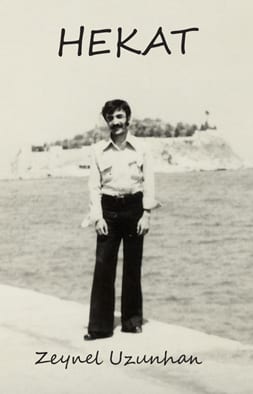
Hekat
Zeynel Uzunhan's memories, turned into stories
Zeynel Uzunhan was born in 1948 in the village of Harmanözü (Macur) in Bayburt. "While my father, my uncles and my aunts were reaping the field we called the stony field, my mother gave birth to me with the help of Gülüstan Ana, who delivered every woman in the village," he says. He is the eldest of eight children, six girls and two boys. His father, seeing that his son would end up a ploughman too if they stayed in a village with no road, no school and no electricity, found work at the Malatya sugar factory and moved the family there the year he was due to start school. He went through primary, middle and high school in Malatya, and the Academy of Economic and Commercial Sciences in Istanbul. He retired in 1999.
Foreword
In Beşiktaş, at Meraklı Köftecisi — now a smart fish restaurant, back then, between us, quite filthy but so cheap that only we students at the dormitory would go — I was eating my meal when I thought of the tables my mother, the sultan of kitchens, used to lay: tables that wanted for nothing. I paid out the last of the money in my pocket and left. Walking slowly up the Akaretler slope to the dormitory under a fine drizzle, my mind stayed at those tables.
My father told stories at those tables. About his youth, about our childhood, about his friends, about the foreign countries he had been to — wherever the subject took us. I had grown up on the stories my father told, each one tied off with a moral at the end. Had I grown up, though?
Much later I realised I was trying to follow my father's footsteps in Istanbul. At Meraklı I was eating in the conditions he had eaten in, going as short of money as he had, looking the way he looked, trying to become what he was. Why? Because I was friends with the heroes of his stories — and usually that hero was my father himself — and I wanted to be with my friends. My father's youth walked Istanbul with me like an old friend.
Listening to my father's table stories always made me a little sad, too. Even hearing one for the hundredth time, it grieved me that the pleasant moment of its telling would fly off into the past. So after he retired I insisted for years: write these down, father.
In the end he began to write. And as he wrote, we took great pleasure in it, because he had never told most of what he wrote. On top of that he wrote like a practised writer — fluent, warm, sincere. This book is what came of it. It makes no literary claim. These are simply my father's memories turned into stories. We are publishing them in all their bareness, in his own words and his own hand.
Taking heart from a fundraising campaign I had supported earlier, we decided to earn something from the book and give it to university students as scholarships. We hope in this way to create some synergy and make a contribution to life, however inadequate.
He has so many more stories left to tell…
Barış Uzunhan, May 2010
- Written by
- Zeynel Uzunhan
- Year
- 2010